LLM
Understands and reasons.
From First Prompt to Working AI Agent.
Stop just experimenting with AI. Learn how to build intelligent applications that can reason, use tools, process information and accomplish real-world tasks.
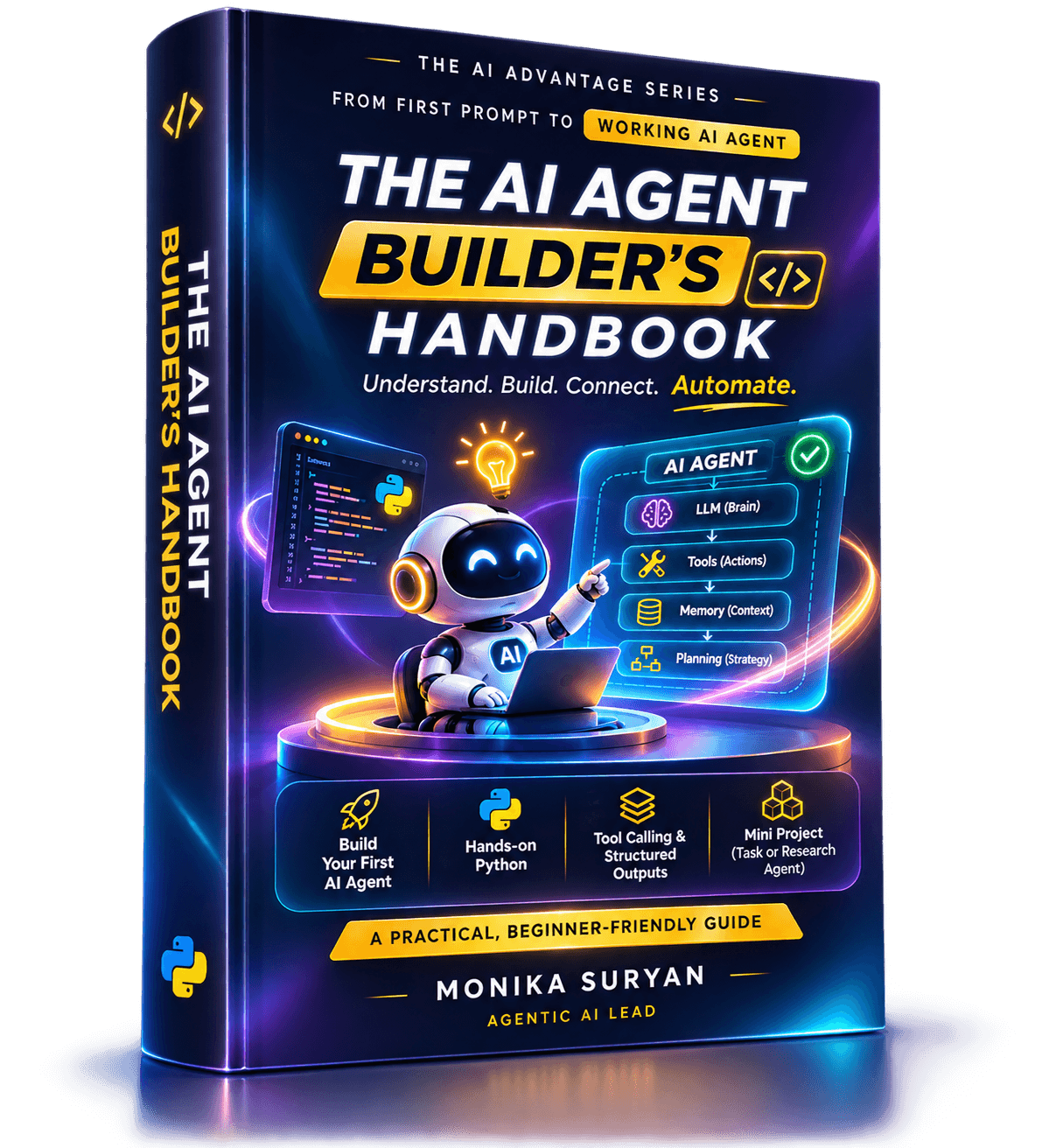
Most people use AI to ask questions and generate answers. But what if you could build systems that understand instructions, select tools, execute tasks and adapt based on results?
See how a request flows through an agent — from reasoning to tool execution and a final response.
Understands and reasons.
Connects to external capabilities.
Retains relevant context.
Breaks goals into steps.
Coordinates execution.
Understand agents, chatbots, automation and agentic AI.
Understand LLMs, tools, memory, planning and orchestration.
Connect LLMs to Python functions and external tools.
Create predictable, structured AI responses.
Understand conversation history and persistent memory.
Understand multi-step tasks and the agent execution loop.
Learn permissions, validation and human approvals.
Test agent performance, reliability and accuracy.
A memorable five-step system for designing practical AI agents.
Define the problem and the agent's objective.
Connect functions and external capabilities.
Add instructions, memory and relevant information.
Let the agent decide the next step and handle tool results.
Evaluate accuracy, reliability and safety.
Learn how an AI model requests a tool call and how your Python application executes it.
def calculate_total(price, quantity): return price * quantity result = calculate_total(250, 4)print(result)instructions = """You are a task automation agent.Use tools to manage tasks.Return answers based on tool results."""tool = { "name": "add_task", "description": "Add a new task", "parameters": { "title": "string", "priority": "low|medium|high" }}Learn how an AI model requests a tool call and how your Python application executes it — without claiming production-ready software out of the box.
Bring all the concepts together in a practical project. Build an AI agent that understands natural-language requests and manages tasks using Python tools.
Turn LLM knowledge into tool-using applications.
Bridge traditional backend skills with agentic systems.
Move from prompts to practical agent architecture.
Build a portfolio-ready mini agent project.
Learn the building blocks before frameworks.
Understand how intelligent task systems actually work.
No advanced AI knowledge is required. Basic Python familiarity will help you get the most from the hands-on examples.
Examples use Python and the OpenAI API. The core concepts transfer to other LLM providers.
The language used for tools, schemas and the agent loop.
The reasoning layer that interprets goals and plans actions.
Examples use the OpenAI API for chat and function calling.
How models request tools and how Python executes them.
Predictable responses your application can trust.
Introduced as next steps — concepts stay transferable.

Monika works in AI and software development, building AI-powered applications, intelligent agents and practical automation systems. Through The AI Advantage Series, she aims to make AI easier to understand and more practical to implement.
Start building your first AI agent today.
Digital PDF · Lifetime access
Start building your first AI agent today.
Basic Python familiarity helps you follow the hands-on examples. You do not need advanced AI or backend experience.
Yes. It is written for beginners who want practical explanations and a clear path from concepts to a working agent.
Python. The examples use Python with the OpenAI API, and the core concepts transfer to other LLM providers.
Yes, if you want to run the coding examples yourself. You can still read and learn the architecture without running every example.
Yes. The handbook walks you through building a personal task automation agent that uses tools and returns results from real function calls.
It introduces agent frameworks at a high level so you know what comes next. The hands-on project focuses on building an agent with Python and the OpenAI API.
It is a digital PDF ebook. You can read it on your phone, tablet or laptop.
After a successful payment on Razorpay, you receive instant access to download the ebook. Keep your payment confirmation email for your records.
Your journey into AI agent development starts with understanding the fundamentals and building something that actually works.
Understand. Build. Connect. Automate.